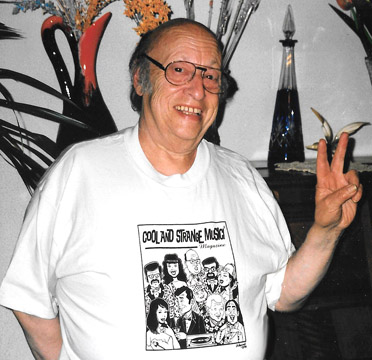
by Dana Countryman
Before we ever met, in 1994 I sent Jean Jacques Perrey a fan letter. I had discovered his records when I was in high school, back in the early '70s, but I never dreamed I'd ever talk to him.I had found his home address in the "Incredibly Strange Music" book. This was a couple of years before I started my music publication, "Cool and Strange Music Magazine").I didn't actually expect to get a response from my fan letter, but a couple of weeks later, I did! Jean Jacques was kind enough to send me a 2-page handwritten letter, as well as a signed photo and a cassette of his rare French library music!I was thrilled, but after that I didn't want to bother him again, as I knew he was famous. I was just delighted with what he had sent.A couple of years later, when I started "Cool and Strange Music Magazine" in 1996, at first I didn't think about approaching JJP for an interview. After the magazine had been in circulation for a couple of years, only then did I get the idea to try and interview him. After I contacted him again, he agreed to a phone interview. I was so excited! (An abridged version of the interview that follows was featured in Issue #10 of the Cool and Strange Music Magazine.) Dana Countryman: Hello, Jean Jacques! This is a thrill to talk to you, I've been waiting a long time for this! DC: We've sent many letters and faxes since then. Well, I would like to talk with you about some of the things not covered in the Incredibly Strange Music book. Tell me about your project in Vancouver with the dolphins. But in your magazine you can say that I am working on a project for helping insomniacs. We've done studies on people who are mentally disturbed. This is related to the dolphin project. It will not be music for recreation, it will be very serious. It is due in the year 2000. So before the year 2000, I cannot say very much about the dolphin project. When it comes out, I think that we will be able to reveal what we have done with the dolphins. We have communicated with them, of course not verbally. They gave us the direction to go with our studies of sleep relaxation and soothing the mentally disturbed. It also deals with therapies for autism, that's also one aspect of it. It is a scientific record for medical research. So, in the year 2000 I will consecrate myself to this big project, which is the project of my life. DC: That sounds very exciting. DC: Your style has always included wacky sounds in the form of tape loops. How did you learn to create these tape loops? I wanted to use the technique to create humorous, popular music. I told him that I was going to America and was going to develop the process in a humorous way. I had his benediction. DC: Listening to your tape loops, I'm totally amazed. It sounds like they must have been mathematically timed out. I can't understand how you could do that in the '60s, without computers, its just amazing. I had a special unit to cut exactly the length. For instance, a half-note was double the quarter, a full-note it was four times, an eighth-note it was half of this. Then I cut the tape with a special ruler. DC: You mean you would you take a piece of tape and measure out markings on the tape before you cut it? I think it is a very important part of my life as a musician. It was really a kind of an invention of a sampler, without the sampling machine being invented yet! DC: Were you influenced by people like John Cage and Karl Stockhausen? DC: Tell me about your song, "Baroque Hoedown", which was used as the theme for the Main Street Electrical Parade at Disneyland. You mentioned in past interviews that you were commissioned to do that piece. Was it actually a composition you had written before you had met Disney and did it have a separate song title? DC: Yes, "Kaleidoscopic Vibrations". DC: You must be pleased, I understand that 75 million people have seen that and have heard your music. That must be quite a thrill. DC: I was in Disneyland with my wife about three years ago, we were standing there at nighttime, watching the Electrical Parade go by, listening to your incredible music. And of course, they did a wonderful job to of writing all of the countermelodies with all of the Disney themes intermingled. DC: Oh, really? DC: You mean the Japanese recording that was released of Kaleidoscopic Vibrations? DC: And you say the it is a different arrangement in Japan? DC: Oh, I see. You're talking about the Disney production. DC: Another question about Disney, one of the interviews I read said that you had worked on some short animated movies with him. DC: Tell me about that, it sounds very exciting. After the show he came to me and he said, "You have a fantastic instrument." It was an Ondioline, the early French synthesizer. He said to me, "I would like you to come to California. I would like you to help provide music for some cartoons." So he made arrangements with his staff of musicians in Hollywood. When I came to Los Angles, I spent one week with his staff. That was really something fantastic for me. DC: You don't remember the names of the cartoons, do you? DC: Was it music you had written, or were you just playing the Ondioline to their songs? DC: I see, speaking of amazing sounds, just recently I have discovered the music of Andre' Popp. "Delirium In Hi-Fi" has become a big favorite of mine. When I listen to it, I hear some of the same kind of humor that I hear in your music. I was wondering if you know him, or are you familiar with his music? DC: He's more of a symphonic musician? DC: And Roger Roger, are you familiar with his music? DC: Would you consider either one of them to be influential for your music? DC: I'm just amazed by your arrangements. DC: Who did the arranging, then? DC: So they would take your melodies and then write arrangements to them? DC: That's amazing, because I know that you don't read music. DC: So you would have all these complex arrangements to play your music on top of. DC: I've turned those records down to 16 rpm many, many times, to try and figure out how you did this or that. Some of the harmonies, sometimes sounds like three or four synthesizers, in those days you could only play one sound at a time. It sounds very lush, very rich. It must of taken hours and hours. DC: Now, what year did you record "The In Sound From Way Out" with Gershon Kingsley? DC: By the time of your album, "The Amazing, New Electronic Pop Sound...," the Moog sounds are much more polished. You have much more control over the instrument, I think. DC: How involved was Harry Breuer in making "The Happy Moog"? His name is on it, but isn't it all you? DC: Now, was that recording done purely in your studio, because it has a different sound than the ones done at Vanguard? When I brought my tape into the studio at Vanguard, they had a 16-track. We'd transfer the 8-track to the 16-track, and then we put the (backing) musicians on top of it. I had better control of the Moog because of my 8-track machine. DC: I understand the early days of the Moog, it would go out of tune a lot and was very hard to keep in tune. Was that true? DC: Did Robert Moog send a representative to help with the synthesizer? I know a lot of times he would send people, like Paul Beaver to help with the recordings to make sure that people would be able to use the instrument. DC: So he was actually in the studio when you recorded those records? Robert Moog? DC: What did you think when you had used the Ondioline for so long, and it was so small, and then all of a sudden you had this huge console Moog synthesizer, with all these switches and buttons? What did you think? DC: Afraid to touch it? DC: That's amazing that you've gone back to how you started, basically. After all these years, you going back to the Ondioline. DC: It's very similar to Robert Moog, he's gone back to the Theremin. Just like he started out in high school, making them out of radio parts. Now he's started his own new company to produce Theremins. DC: Oh really? When I was in high school I was able to play one of the console Moogs at one of the local schools. That was a really big thrill for me. Those are very collectable now, its very hard to find those. DC: I've noticed that a lot of your music sounds like it has a lot of ragtime influence. Particularly on "The Happy Moog," and a couple of other albums, too. Were you influenced by ragtime? DC: Now speaking of commercials, I know that you have won a couple of Clio Awards. One for the Volkswagon commercial? DC: I see, and what about the song, "The Savers"? DC: You say you have recorded many, commercials. Do you have recordings of all the commercials you've done? DC: You recently transferred a lot of your tape loops onto your Kurzweil, it that correct? DC: So, now you don't have to worry about the tape breaking down! DC: Now I know you left the US for good in 1970, for family reasons. Then you worked with the ballet company, is that right? DC: Then, you recorded several albums of cartoon music? DC: Fantastic. DC: I've noticed that your daughter, Pat Prilly is credited a lot of your songs. DC: That's great, I never knew that. So she would actually be playing next to you on the organ? DC: It's been almost 30 years since you left the U.S. Why the long gap of time between then and now in the public eye? DC: How do you feel about people sampling your music without getting your permission or paying for it? DC: A lot of them don't even put your name on the record, I don't think that's right. DC: That's a very generous attitude, actually. DC: You're doing a lot of live performances again. Do you enjoy performing? DC: When you came to the U.S., I know that you did a lot of performances on American television and radio. DC: So, you were demonstrating the Ondioline on "The Captain Kangaroo Show"? DC: In 1993, the Incredibly Strange Music book came out, with your interview in it. I think it brought a lot of interest to your music. Have you noticed that book has made an impact? DC: Your manager, Lisa tells me that you're going to be coming to the U.S. to do lectures at some Universities. That sounds very exciting. DC: Will that be just by yourself or with other musicians? DC: I understand that you will be demonstrating your techniques for making the tape loops. DC: You have been doing some live shows in Europe, with some live musicians. Any possibility of bringing your show with the live music to the U.S.? DC: When you come over here I hope you have all the success that you deserve. I think it's fantastic that people are discovering your music, because I was listening to it when I was 15 and 16 years old, and I'm still listening to it and I'm 43 now! DC: Are there any things that you would like to talk about that I haven't brought up? Any messages? Anything about your career that hasn't been really talked about? I am grateful to Carroll, who is dead now, who built the studio for me. I am grateful to Walt Disney, who is also dead. To all those people who are helping me now to come back to United States, Lisa and yourself. You have a very good magazine - it's becoming very popular also in England and France. DC: Little by little, we're starting to creep into other countries, I'm very pleased about it. Your music and lots of the other music that we feature is really coming back. I think people are getting away from the negative rap and negative rock 'n' roll and coming back to the positive, good-feeling music. DC: Well Jean Jacques, this has been great. I really appreciate your spending this time with me. I hope to see you in the U.S. soon.
|